
Spring Hill has plenty of golf carts. Some are used daily for trips around the neighborhood, to visit friends, or to get to a community pool or clubhouse. Others come out on weekends. Plenty sit for weeks while their owners travel. Each of those patterns is hard on batteries in a different way, and Hernando County’s long, hot summers make all of them harder.
This guide lays out a practical year-round routine for Spring Hill cart owners, with notes on both flooded lead-acid and lithium packs.
How carts tend to be used here
Most carts around Spring Hill are not on a golf course all day. They are used for short trips with long rests in between, stored in garages that heat up quickly in summer, and charged whenever the owner remembers to plug them in. A few patterns stand out:
- Short, frequent trips. Lots of starting and stopping, with modest distance.
- Garage storage. Garages without air conditioning can get very hot in summer, and the cart’s charger adds heat too.
- Seasonal travel. Some owners leave for weeks or months at a time.
- Lifted carts and accessories. Larger tires, lights, sound systems and seats add load and weight.
Each of these affects how you should care for the batteries.
Spring: get ready for the heat
Late March through May is the time to get the cart ready for summer.
- Test the pack. Each battery should be tested individually after a full charge. One weak battery drags down the whole pack. Our article on golf cart battery load testing explains the process.
- Check water levels on flooded batteries, and top up with distilled water after charging. The golf cart battery watering guide covers the steps.
- Clean terminals and battery tops. Neutralize any acid residue and apply terminal protector.
- Tighten connections. A loose cable heats up under load and can damage a post.
- Check the charger. Make sure it completes a full charge cycle and shuts off properly.
Summer: watch heat and water
Summer is the hardest season on golf cart batteries in Spring Hill.
- Check water more often. Heat increases water loss in flooded batteries. Many owners check every couple of weeks.
- Charge after every use, even short trips. A lead-acid pack left partly discharged in heat sulfates quickly.
- Ventilate the garage during charging if possible. Opening a door or running a fan helps.
- Keep the cart out of direct sun when parked for long periods.
- Watch for swelling, heat or smell. A battery that is hot to the touch or smells like rotten eggs needs attention.
For lithium carts, follow the manufacturer’s temperature guidance. The BMS may limit charging when cells are too hot. See what a lithium BMS does.
Fall: recheck after the hot months
Batteries often fail in the fall because summer did the damage. In September or October:
- Retest the pack. Compare with spring results.
- Look for any battery falling behind the others.
- Plan replacements before the busier winter months if the pack is near the end of its life.
Winter: the busy season
Cooler weather often means more cart use. Carts are out more, and visitors come to town.
- Keep up with charging. More use means more charging cycles.
- Keep watering on schedule, even though water loss slows in cooler months.
- Watch range. If range is dropping, find the cause early. See why your golf cart is losing range.
If you leave for weeks or months
Storage is where many Spring Hill golf cart batteries are lost. Before leaving:
For lead-acid carts
- Fully charge the pack.
- Check and top up water after charging.
- Clean battery tops and terminals.
- Either leave the cart on a charger designed for long-term maintenance, if the manufacturer allows it, or disconnect the main pack and arrange for someone to recharge it periodically.
- Put the cart in tow or storage mode if it has one.
Never leave a lead-acid pack sitting discharged for weeks in summer. It may not recover.
For lithium carts
Follow the battery manufacturer’s storage guidance. Many lithium packs prefer storage at a partial charge, with the battery disconnected or switched off.
Lifted carts and accessories
Lifted carts with larger wheels, light bars, sound systems and extra seating are popular, and they are fun. They also ask more of the batteries. Bigger tires take more energy to turn, extra seats invite more passengers, and accessories draw power both while driving and, if wired poorly, while parked.
If you have added accessories, a few habits help:
- Make sure accessories are wired through a proper voltage reducer and switched off when the cart is parked.
- Expect somewhat shorter range than a stock cart, and charge accordingly.
- Watch the pack more closely for one battery falling behind, since heavier loads expose weak batteries faster.
- When it is time for new batteries, choose a capacity that suits how the cart is actually used, not how it left the factory.
Signs it is time for new batteries
- Range is noticeably shorter than it used to be.
- The cart slows down on hills or toward the end of a trip.
- One battery tests far lower than the others.
- Batteries need water much more often than before.
- Cases are swollen, cracked or leaking.
When it is time, replace the full set of lead-acid batteries together, or consider a lithium conversion. Our guide to lithium golf cart conversion steps explains what that involves.
Frequently asked questions
Should I leave my golf cart plugged in all the time?
It depends on the charger. Many modern chargers are designed to manage the battery and can stay connected. Older chargers may not. Check your charger’s instructions.
How often should I check the water in summer?
More often than the rest of the year, as often as every couple of weeks for carts that are used and charged frequently.
Can I use tap water if I run out of distilled?
It is better not to. Minerals in tap water build up on the plates over time.
Golf cart battery service in Spring Hill
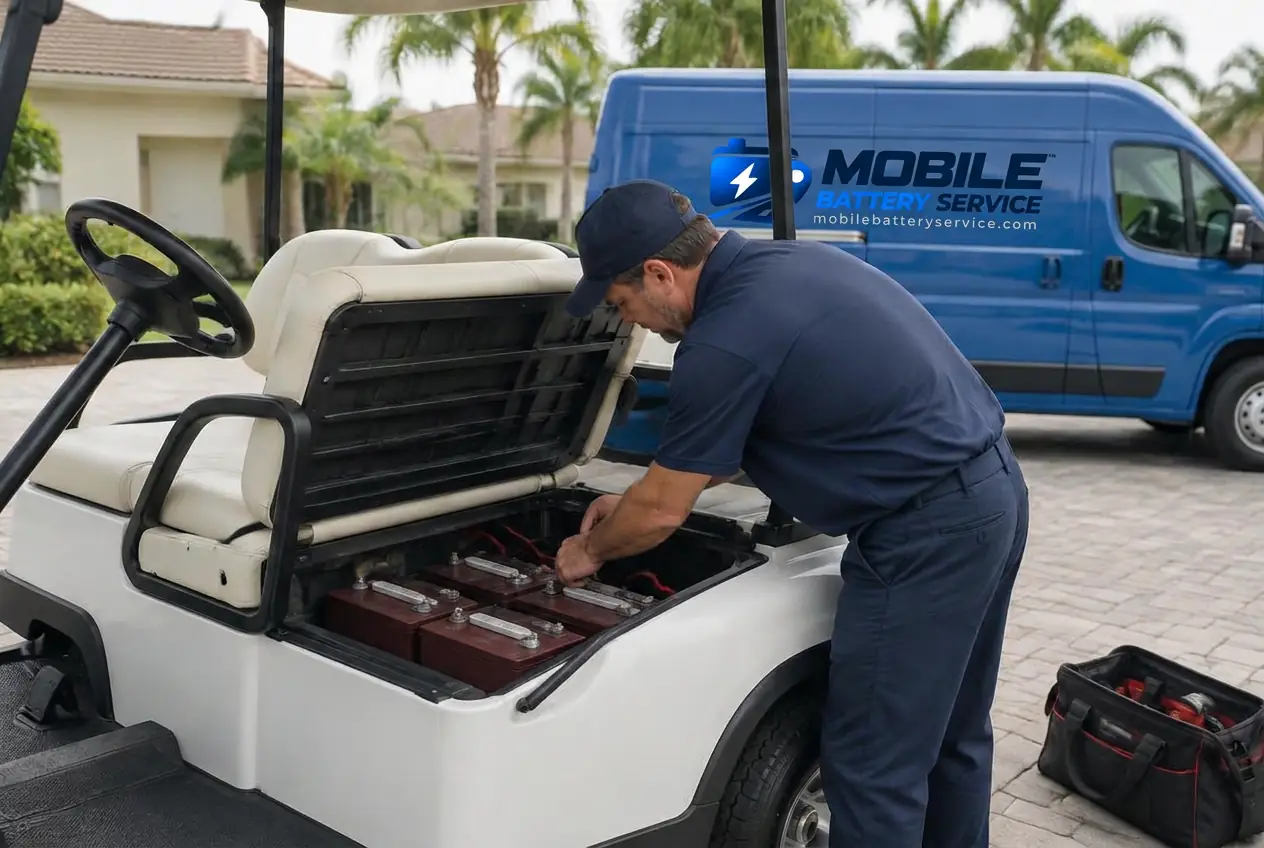
Our golf cart battery service comes to your driveway or garage in Spring Hill, Weeki Wachee, Brooksville and across Hernando County. We test each battery, clean and protect terminals, and handle replacements for 6V, 8V and 12V packs. If you are tired of watering, ask about our lithium battery upgrades.
Related services
Related posts
Local Battery Guides · Oct 28, 2026 · 5 min read
Coming Home to a Dead Battery After Airport Parking in Tampa
You land, find your car in long-term parking, and it will not start. Here is why that happens so often in Tampa, and how to avoid it on…
Golf Cart Batteries · Oct 28, 2026 · 5 min read
Why Your Golf Cart Is Losing Range and How to Find the Cause
When a cart that used to run all day starts dying halfway through, the cause is usually one of a handful of things. Here is how to work…
Lithium & LiFePO4 · Oct 28, 2026 · 5 min read
What Happens During a Lithium Golf Cart Conversion, Step by Step
A lithium conversion replaces your cart's lead-acid pack with LiFePO4. Here is what the process involves, what gets checked, and what changes for you afterward.
Golf Cart Batteries · Oct 28, 2026 · 5 min read
One Bad Golf Cart Battery: Replace One or the Whole Set?
Your cart has one battery testing weak. Should you swap just that one, or the whole set? Here is how to decide without wasting money.
Popular battery guides
- How Long Do Car Batteries Last in Florida?
- Golf Cart Batteries: Lithium vs. Lead-Acid
- Signs Your Car Battery Is Failing
- Forklift Battery Maintenance Checklist
- What to Do When Your Car Won’t Start
- AGM vs. Standard Car Batteries: Which Do You Need?
Where we work
We come to you across Hernando County, Pasco County, Pinellas County, and Hillsborough County. See all mobile battery services or read more about Mobile Battery Service.