
If your golf cart runs on traditional flooded lead-acid batteries, watering them is the single most important piece of maintenance you can do. It is also the one most often done wrong. Too little water and the plates are exposed and damaged. Too much and acid bubbles out over the top of the pack, corroding everything it touches. Get the timing and the level right, and a pack lasts noticeably longer.
This guide covers flooded batteries only. Sealed AGM and lithium batteries do not need water. If you are not sure which type you have, look for removable vent caps on top of each battery. If you can pop the caps off and see liquid inside, you have flooded batteries.
Why golf cart batteries need water
Flooded batteries contain lead plates sitting in electrolyte, a mix of sulfuric acid and water. Every time the battery charges, especially near the end of the charge, some of that water is split into hydrogen and oxygen gas and vented out. The acid stays behind. Over time the water level drops.
In Florida, heat speeds this up. A cart stored in a hot garage in Spring Hill in July and charged daily can lose water much faster than the same cart in a cooler climate. We go into the summer side of this in heat and golf cart water loss.
When to check and when to add
Check regularly
A good starting point is checking the water level every two to four weeks, and more often in summer or if you use the cart heavily. New batteries tend to use less water at first; older batteries use more.
Add water after charging, not before
This is the rule people most often get backward. Add water after the batteries are fully charged, not before. Electrolyte expands as the battery charges. If you fill to the top before charging, it will overflow during the charge.
The one exception: if the plates are exposed before charging, add just enough water to cover the plates, then charge, then top up to the correct level afterward.
How much water to add
Inside each cell you will see the tops of the plates and, above them, a plastic fill well or indicator. The target is generally:
- Enough water to cover the plates fully.
- Filled up to the bottom of the fill well, usually about a quarter to half inch below the bottom of the vent opening.
- Never filled to the very top.
Check the manufacturer’s guidance for your batteries, since specific levels vary slightly.
Use distilled water only
Use distilled or deionized water. Tap water and well water contain minerals, and those minerals end up coating the plates and reducing capacity. Rain barrel water and bottled spring water have the same problem. We compare options in distilled vs. tap water for golf carts.
Step-by-step watering
- Charge the cart fully and let it finish its charge cycle.
- Put on safety glasses and gloves. Battery acid is corrosive.
- Wipe the top of the batteries so dirt does not fall into the cells when you open them.
- Remove the vent caps one battery at a time.
- Look into each cell. You are checking whether the plates are covered and where the level sits relative to the fill well.
- Add distilled water to the correct level. A battery filler bottle with an automatic shutoff makes this easier and avoids overfilling.
- Replace the caps securely.
- Rinse spills with a little baking soda solution, and dry the battery tops.
On a 48-volt cart with six 8-volt batteries, that is 24 cells to check, so take your time.
Watering systems
Single-point watering systems connect every cell through tubing so you can fill the whole pack from one point. They save time and reduce mistakes, as long as they are maintained. If one is installed, it still needs the cart to be fully charged first, and the tubing should be checked for cracks and blockages.
Common watering mistakes
- Filling before charging. Leads to overflow and acid on the battery tops.
- Overfilling. Electrolyte boils out, the acid gets weaker, and corrosion spreads to cables and the battery tray. See golf cart battery tray rust.
- Letting plates dry out. Exposed plates sulfate and lose capacity for good.
- Using tap water. Minerals build up over time.
- Adding acid. Do not add acid. Water is lost during charging; the acid stays.
We list more in golf cart watering mistakes.
What low water does to a pack
When plates sit above the electrolyte, the exposed part sulfates and stops contributing. Each cell has less usable capacity. Because batteries in a cart are wired in series, one weak battery pulls down the whole pack. You will notice shorter range, slower hill climbing and a cart that seems tired by the end of a round.
When watering will not fix it
If your cart has lost range despite good watering, the batteries may be worn out, or one battery may be failing. A golf cart battery load test can identify which battery is weak. On every visit, we include a free battery test, terminal cleaning and anti-corrosion treatment.
Frequently asked questions
How often should I water golf cart batteries in Florida?
Check every two to four weeks to start, more often in summer and with heavy use. Over time you will learn how quickly your pack drinks.
Can I use bottled drinking water?
Only if it is labeled distilled. Spring water and purified drinking water may still contain minerals.
What if acid is all over the tops?
That usually means overfilling. Clean and neutralize it, check cables for corrosion, and fill to the correct level after charging next time.
Golf cart battery help in Hernando County
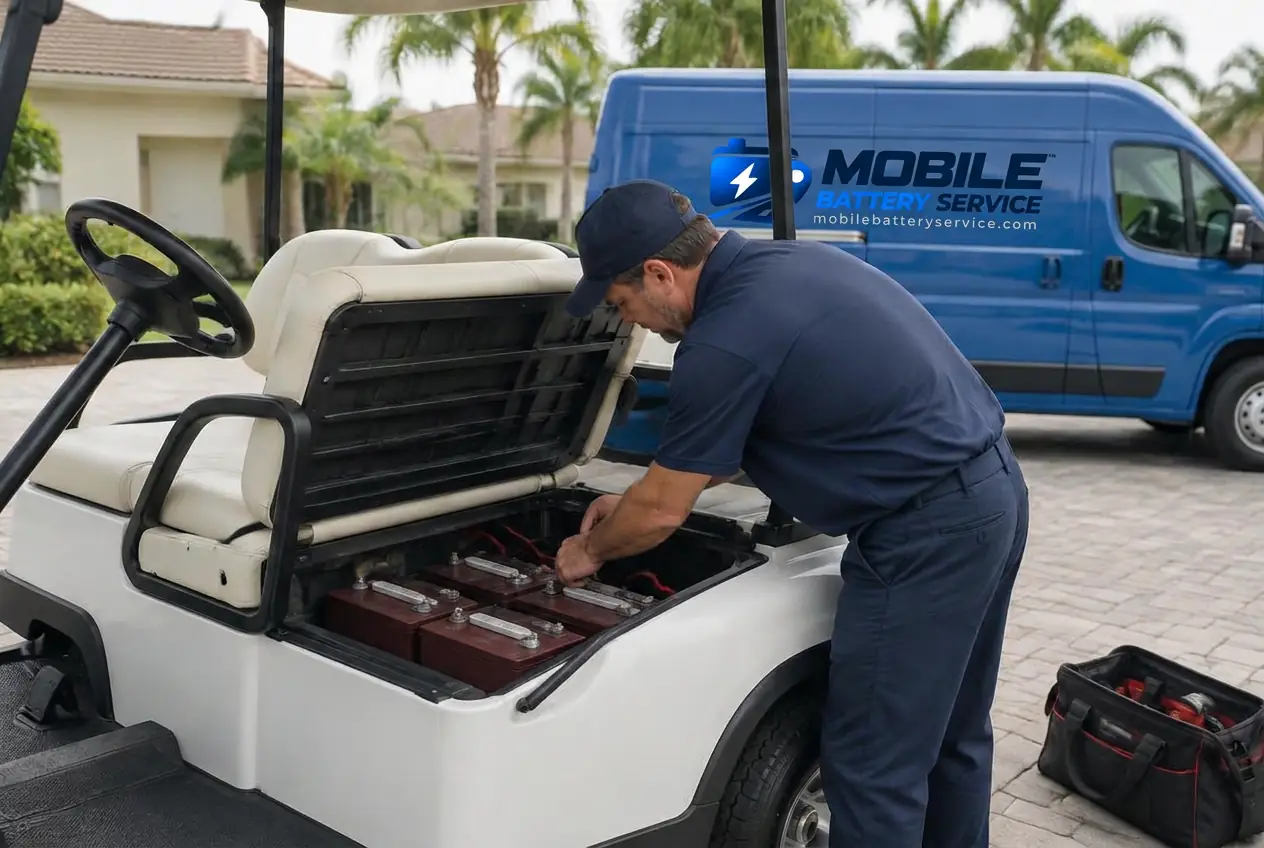
If you are not sure your watering routine is right, or the cart just is not what it used to be, our golf cart battery service comes to your home in Spring Hill or nearby. We check every cell, test each battery, and tell you whether the pack needs attention. If you are tired of watering altogether, ask about lithium battery upgrades.
Related services
Related posts
Golf Cart Batteries · Oct 28, 2026 · 5 min read
Why Your Golf Cart Is Losing Range and How to Find the Cause
When a cart that used to run all day starts dying halfway through, the cause is usually one of a handful of things. Here is how to work…
Golf Cart Batteries · Oct 28, 2026 · 5 min read
One Bad Golf Cart Battery: Replace One or the Whole Set?
Your cart has one battery testing weak. Should you swap just that one, or the whole set? Here is how to decide without wasting money.
Golf Cart Batteries · Aug 28, 2026 · 1 min read
Golf Cart Batteries: Lithium vs. Lead-Acid
Comparing cost, lifespan, range and maintenance so you can choose the right batteries for your cart.
Golf Cart Batteries · Oct 28, 2026 · 5 min read
6V vs. 8V vs. 12V Golf Cart Batteries: What the Difference Means
Six 8-volt batteries, eight 6-volt batteries, four 12-volt batteries: they can all add up to 48 volts. Here is what the difference means for your cart.
Popular battery guides
- How Long Do Car Batteries Last in Florida?
- Golf Cart Batteries: Lithium vs. Lead-Acid
- Signs Your Car Battery Is Failing
- Forklift Battery Maintenance Checklist
- What to Do When Your Car Won’t Start
- AGM vs. Standard Car Batteries: Which Do You Need?
Where we work
We come to you across Hernando County, Pasco County, Pinellas County, and Hillsborough County. See all mobile battery services or read more about Mobile Battery Service.