
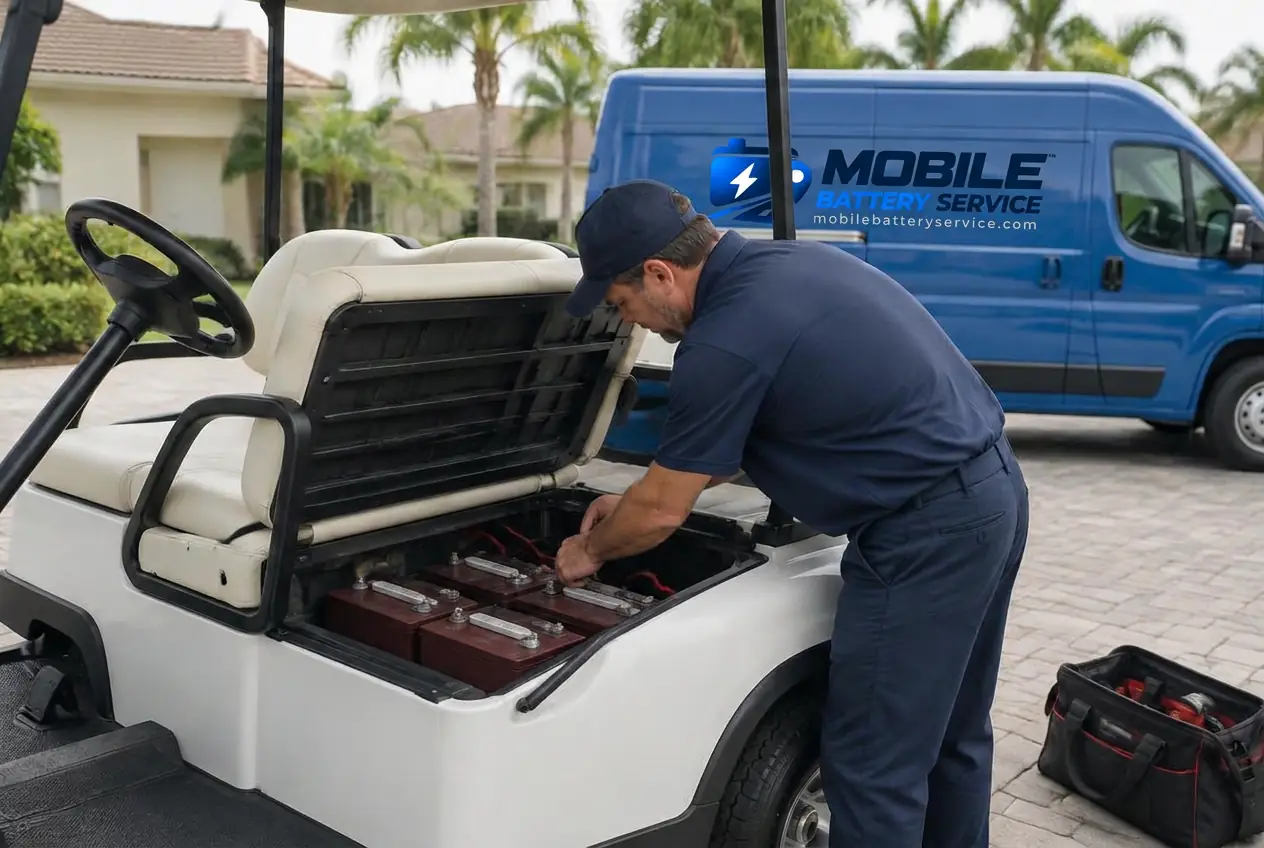
Lift the seat on a golf cart and count the batteries. You might find six, eight or just four. Look closer and the labels say 6 volts, 8 volts or 12 volts. Owners often wonder why carts differ so much, and whether they can switch from one setup to another when it is time to replace.
The short answer: the batteries are wired in series to reach the cart’s system voltage, and different combinations get there in different ways. Each setup has trade-offs in range, weight, cost of replacement and maintenance.
How the math works
Golf cart batteries are wired in series: the positive of one battery connects to the negative of the next. In a series string, voltages add together while capacity stays the same as a single battery.
Common combinations:
- 36-volt cart: six 6-volt batteries.
- 48-volt cart: six 8-volt batteries, eight 6-volt batteries, or four 12-volt batteries.
The cart’s motor, controller and charger are built for a particular system voltage. Whatever batteries you choose must add up to that voltage. If you are unsure of yours, our post on 36V vs. 48V golf carts shows how to tell.
Why the individual battery voltage matters
A lead-acid battery is made of 2-volt cells. A 6-volt battery has three cells, an 8-volt battery has four, and a 12-volt battery has six. The physical size of these batteries is often similar. So a bigger voltage per battery generally means less room for plate material in each cell, and that affects capacity.
6-volt batteries
Six-volt deep cycle batteries have fewer cells in the same space, which allows thicker plates and more capacity per cell. That typically means more amp hours and longer range. The trade-off is that you need more of them: eight 6-volt batteries to make 48 volts. More batteries means more weight, more cells to water and more connections.
8-volt batteries
Eight-volt batteries are a common factory choice for 48-volt carts because six of them fit neatly under the seat. Capacity per battery is generally lower than a comparable 6-volt battery, but you have fewer to maintain.
12-volt batteries
Four 12-volt batteries make 48 volts with the fewest batteries and connections. They are lighter overall but typically have the lowest amp hours of the three options, which can mean less range.
Range: amp hours are what matter
Range depends on usable energy, which is roughly voltage times amp hours. Two 48-volt packs can have very different range if one uses higher-capacity batteries. When comparing options, look at the amp hour rating at the 20-hour rate, which is the usual figure for deep cycle batteries. Higher amp hours at the same voltage means more stored energy.
Other factors affect range too: hills, tire size, lift kits, passenger weight, how often you accelerate hard, and how well the batteries have been watered and charged.
Maintenance differences between the setups
The number of batteries changes the amount of routine care a pack needs, and that is worth thinking about honestly before you choose.
Watering
Every flooded cell needs water. A pack of eight 6-volt batteries has 24 cells, six 8-volt batteries also have 24 cells, and four 12-volt batteries have 24 cells as well. The cell count works out the same at 48 volts, because the system voltage is fixed. What changes is the number of caps and batteries you move between, and how easy each one is to reach under the seat. A tight compartment with eight batteries can be awkward to water without a single-point watering kit.
Connections
More batteries means more cables and more terminals, and every terminal is a place where corrosion and looseness can start. Eight batteries in series have more connections than four. Each one needs to be clean and tight, because a single loose connection can heat up under load and damage a post. Cleaning golf cart terminals shows how to keep them in shape.
Testing
When a pack starts losing range, the job is finding the weak battery. With four batteries that is quick; with eight it takes a little longer, but the process is the same. Each battery is tested on its own after a full charge, and ideally under load.
Weight and the cart itself
Lead-acid batteries are heavy. More batteries usually means more total weight, which affects how the cart handles on soft ground, how hard the brakes work and how much wear the suspension sees. On a lifted cart with large tires and a rear seat full of passengers, the weight adds up quickly.
Can you switch from 8V to 6V or 12V?
Often yes, as long as the total voltage stays the same and the batteries fit. Points to consider:
- Space. Eight 6-volt batteries need a larger battery compartment than six 8-volt batteries. Some carts need a different tray or rack.
- Cables. A different number of batteries means a different cable layout.
- Charger. The charger must match the system voltage and, ideally, the battery type.
- Weight. Eight 6-volt batteries add weight.
If you are considering a change, a technician should confirm the fit. Our golf cart battery service covers 6V, 8V and 12V packs.
Replace as a set
Whatever the voltage, replace all the batteries in the pack at the same time. In a series string, the weakest battery limits the whole pack. Mixing new and old batteries leads to the new ones being overworked. We explain why in mixing old and new golf cart batteries.
Where lithium fits in
Lithium (LiFePO4) packs for golf carts are typically a single battery or a small number of modules that replace the entire lead-acid set. They are much lighter and do not need watering. A lithium conversion is a different project than swapping like-for-like batteries; our lithium golf cart conversion steps cover what is involved, and our lithium battery upgrades page explains the service.
Frequently asked questions
Which lasts longer: 6V or 8V golf cart batteries?
Both can last a long time with good care. Six-volt batteries are often favored for capacity, but watering, charging habits and heat matter more than the label.
Can I use car batteries in a golf cart?
No. Car batteries are starting batteries designed for short, high bursts, not deep cycling. See starting vs. deep cycle batteries.
My cart has six batteries. Is it 36 or 48 volts?
Check the label on one battery. Six 6-volt batteries is 36 volts; six 8-volt batteries is 48 volts.
Help choosing the right pack near Brooksville
If your cart is due for new batteries and you are weighing options, we come to you in Brooksville and the rest of Hernando County, test the current pack, confirm the system voltage and fit, and explain the trade-offs before anything is installed.
Related services
Related posts
Golf Cart Batteries · Aug 28, 2026 · 1 min read
Golf Cart Batteries: Lithium vs. Lead-Acid
Comparing cost, lifespan, range and maintenance so you can choose the right batteries for your cart.
Golf Cart Batteries · Oct 28, 2026 · 5 min read
Why Your Golf Cart Is Losing Range and How to Find the Cause
When a cart that used to run all day starts dying halfway through, the cause is usually one of a handful of things. Here is how to work…
Golf Cart Batteries · Oct 28, 2026 · 4 min read
How to Water Golf Cart Batteries the Right Way
Flooded golf cart batteries need water, and Florida heat makes them thirsty. Here is when to water, how much to add, and the mistakes that quietly kill a…
Golf Cart Batteries · Oct 28, 2026 · 5 min read
One Bad Golf Cart Battery: Replace One or the Whole Set?
Your cart has one battery testing weak. Should you swap just that one, or the whole set? Here is how to decide without wasting money.
Popular battery guides
- How Long Do Car Batteries Last in Florida?
- Golf Cart Batteries: Lithium vs. Lead-Acid
- Signs Your Car Battery Is Failing
- Forklift Battery Maintenance Checklist
- What to Do When Your Car Won’t Start
- AGM vs. Standard Car Batteries: Which Do You Need?
Where we work
We come to you across Hernando County, Pasco County, Pinellas County, and Hillsborough County. See all mobile battery services or read more about Mobile Battery Service.