
Few things are more confusing than a car that will not start, a battery that tests perfectly fine, and a parts store employee shrugging. A passing battery test is useful, though. It tells you where not to spend more money, and it narrows the search. The trick is knowing what to check next, and in what order.
This guide assumes the battery has been properly tested, with a conductance or load test, not just a voltage check. If it has only been checked with a multimeter, start with a real test first, because a battery can show good voltage and still be weak. Our 12-volt battery voltage chart explains why.
First: what does “won’t start” look like?
The symptoms point in different directions, so be precise:
- No crank, no click, dash lights on: the starter is not being told to engage, or power is not reaching it.
- Single click, no crank: power reaches the solenoid but not the starter motor, or the starter is failing.
- Rapid clicking: usually low voltage at the starter, often from a battery or connection issue.
- Cranks normally but will not start: the starting system works; the issue is fuel, spark, air or the security system.
- Cranks slowly: something is limiting current, or the battery is weaker than the test suggests under real conditions.
Our article on what clicking with no crank means goes deeper into those sounds.
The connections between battery and starter
A battery can be healthy while the path from the battery to the starter is not. That path includes:
Battery terminals and clamps
A clamp that looks tight can still be loose enough to cause a no-start, because the starter draws very high current. Corrosion between the clamp and the post adds resistance. Try twisting each clamp by hand; if it moves, it is too loose.
Battery cables
The main positive cable runs from the battery to the starter, often with a branch to the fuse box. The negative cable runs to the engine block or body. Corrosion can travel up inside the insulation where you cannot see it, raising resistance. A cable may look fine outside and be green inside.
Ground connections
Engines are mounted on rubber, so they rely on ground straps to complete the circuit. A corroded or loose ground between engine and body, or body and battery negative, can stop a starter cold. Our post on bad ground connection symptoms covers this common culprit.
Measuring voltage drop
The best way to check these connections is a voltage drop test: measuring the voltage across each cable and connection while the engine is being cranked. Any significant drop points to excess resistance in that part of the circuit. It is a quick test for a technician and far more reliable than looking. We explain it in voltage drop testing on battery cables.
The starting system beyond the cables
Starter motor and solenoid
Starters wear out. Brushes wear, bearings drag, and solenoid contacts burn. A failing starter might click once and do nothing, work intermittently, or grind. Heat sometimes makes it worse. A worn starter is a repair shop job.
Starter relay and fuses
Many vehicles use a relay to send power to the solenoid. A failed relay or blown fuse can prevent cranking entirely.
Ignition switch and push-button start systems
A worn ignition switch, or on push-button vehicles a problem detecting the key fob or brake pedal, can prevent the start signal from reaching the starter. A weak key fob battery can cause this on some vehicles.
Neutral safety and clutch switches
Automatic vehicles will not crank unless they sense park or neutral. Try shifting firmly into park, or try neutral. Manual cars need the clutch pedal fully depressed.
Security and immobilizer systems
If the car does not recognize the key, it may prevent starting. A security light flashing on the dash is a clue. Try a spare key.
If it cranks but will not start
If the engine turns over at normal speed and does not fire, the battery and starter are probably doing their jobs. The problem is more likely fuel delivery, ignition, sensors or the security system. Those need diagnosis by a repair shop.
When the battery is the problem after all
Sometimes a battery passes a test and still causes trouble. A few reasons:
- The test was done right after charging, when surface charge made it look better.
- The battery has an intermittent internal fault, such as a cracked connector inside the case that only fails under heavy load or vibration.
- The battery is borderline, passing at mild temperatures but not on a very hot afternoon.
If the problem keeps recurring and everything else checks out, a retest after the battery has rested, or a load test, can reveal what a quick test missed. Our post on intermittent no-starts covers this.
What we check on site
When we are called for a no-start and the battery tests healthy, we do not just leave. On every visit we include a free battery test, terminal cleaning and anti-corrosion treatment. We also check the cables and connections, since corroded or damaged battery cables are something we can replace on site. If the problem turns out to be the starter, ignition or engine management, we will tell you, so you can go to the right repair shop without paying for a battery you do not need.
Frequently asked questions
Can a bad starter drain a battery?
A starter that sticks engaged or shorts internally can drain a battery quickly, but most failing starters simply stop working.
Could the alternator cause a no-start if the battery tests good?
The alternator does not crank the engine. If the battery is fully charged and tests good, the alternator is not the cause of a no-crank.
Should I replace the battery anyway?
Not if it tests good after a proper test. Replacing a good battery will not fix a cable, ground or starter problem.
No-start help in Tampa
If your car will not start and you are in Tampa, we can come to you with our battery testing service, check the connections, and replace the battery or cables if needed. If you need to get moving, our jump start service covers the whole area.
Related services
Related posts
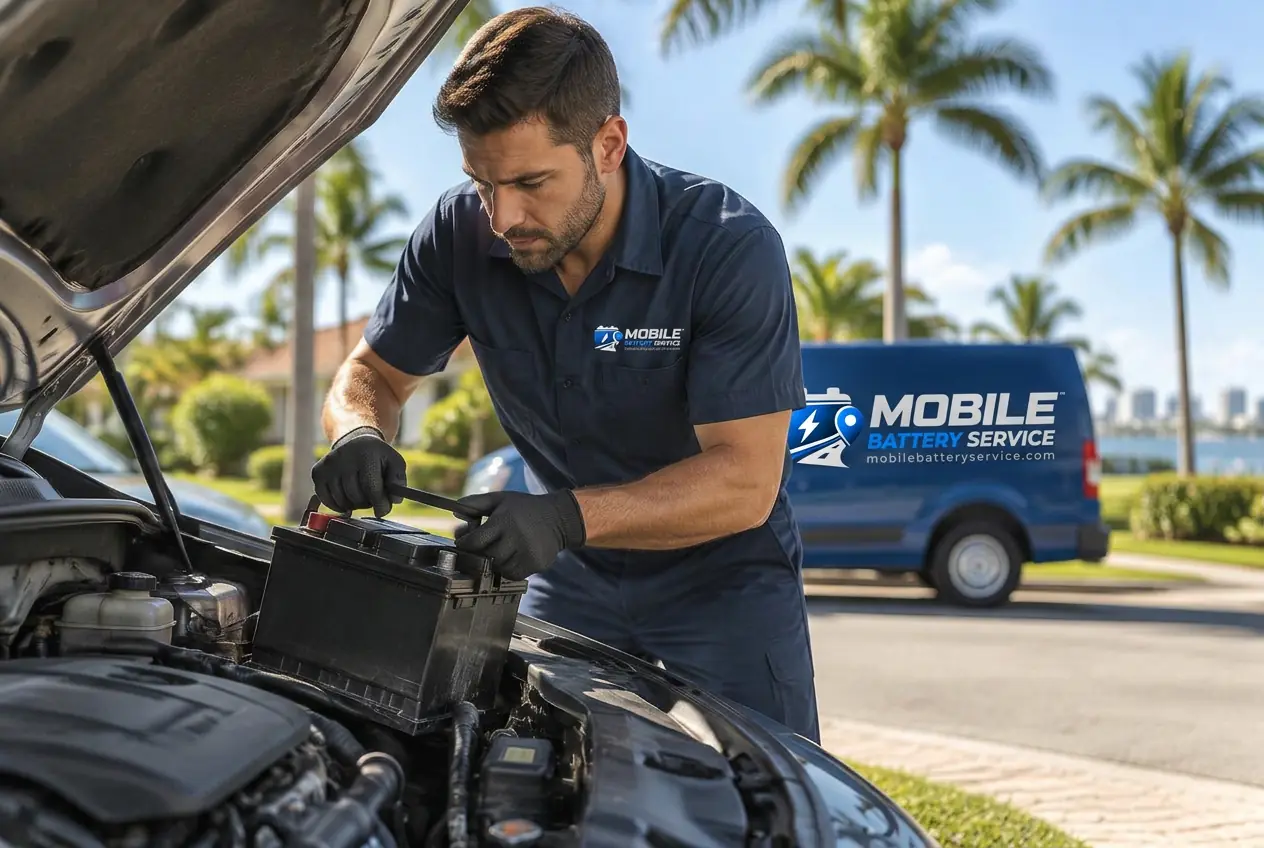
Testing & Troubleshooting · Aug 10, 2026 · 2 min read
Signs Your Car Battery Is Failing
Slow cranking, clicking, a battery that needs jumps? Learn the signs your car battery is failing in Florida heat. We come to you: (855) 660-4300.
Testing & Troubleshooting · Oct 28, 2026 · 5 min read
12-Volt Battery Voltage Chart: What Your Readings Really Mean
12.6 volts, 12.2 volts, 11.8 volts: what do they mean? Here is a plain chart for 12-volt lead-acid batteries, plus the important things a voltage reading cannot tell…
Testing & Troubleshooting · Oct 28, 2026 · 5 min read
Bad Battery or Charging Problem? How to Tell the Difference
Batteries get blamed for a lot, but sometimes the real problem is that the battery is not being recharged. Here is how to tell which one you are…
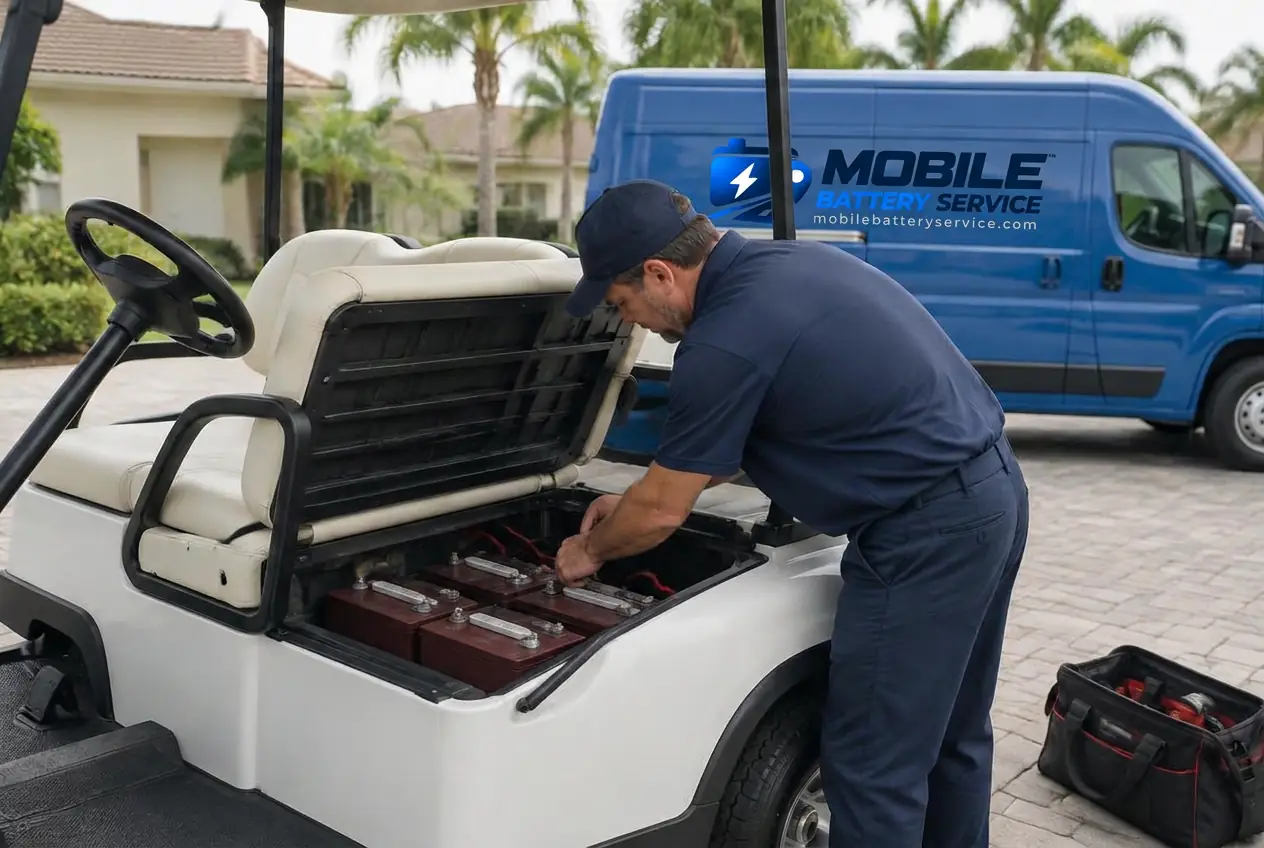
Golf Cart Batteries · Oct 28, 2026 · 5 min read
Why Your Golf Cart Is Losing Range and How to Find the Cause
When a cart that used to run all day starts dying halfway through, the cause is usually one of a handful of things. Here is how to work…
Popular battery guides
- How Long Do Car Batteries Last in Florida?
- Golf Cart Batteries: Lithium vs. Lead-Acid
- Signs Your Car Battery Is Failing
- Forklift Battery Maintenance Checklist
- What to Do When Your Car Won’t Start
- AGM vs. Standard Car Batteries: Which Do You Need?
Where we work
We come to you across Hernando County, Pasco County, Pinellas County, and Hillsborough County. See all mobile battery services or read more about Mobile Battery Service.