
Every Florida resident knows the routine when a storm starts showing up on the forecast cone: water, gas, shutters, supplies. Batteries often come up only as the flashlight kind. But the bigger batteries in your life matter just as much. A car that will not start when an evacuation order comes, a generator that refuses to crank after the power drops, or a golf cart that is flat when you need to check on a neighbor can turn an inconvenience into a real problem.
The best time to deal with batteries is well before a storm is named, when nobody is rushing. Here is a practical plan.
Start early: the beginning of the season
Hurricane season officially runs from June 1 through November 30. A good habit is to do a full battery check in late May or early June, then a quick recheck if a storm threatens.
Make a list of every battery you depend on
Walk around your home and write down:
- Every car, truck and SUV.
- The standby generator, or portable generator with electric start.
- Golf carts and LSVs.
- Boats and their starting and house batteries.
- Tractors, mowers and equipment, if you live on acreage.
- Any lithium or backup power systems for the home.
It is a short list for most households, but it is easy to forget one.
Vehicles
Your vehicle may be your evacuation plan, and roads, gas stations and parts stores can be crowded before a storm and closed after.
- Test the battery. A battery that is borderline in June may not survive a hot summer and a few days of sitting. Every visit we make includes a free battery test.
- Replace weak batteries now, not when a storm is two days out.
- Clean and tighten terminals.
- Know your vehicle’s quirks. If you drive a newer vehicle with battery registration, a hybrid or an EV, understand how its 12-volt battery works. See hybrid and EV 12-volt auxiliary batteries.
- Keep a jump pack charged or cables in the trunk.
- Do not leave accessories plugged in while the vehicle sits during a storm.
Standby and portable generators
The generator is often the most important battery in the house during a long outage.
- Test the starting battery at the start of the season.
- Confirm the built-in charger is working and the controller shows no faults.
- Run the generator’s exercise cycle and listen for a healthy start.
- Check portable generators with electric start, since their batteries often sit flat for months.
Our guide to standby generator starting batteries covers this in detail. We test and replace generator starting batteries; the generator engine, transfer switch and home wiring should be serviced by the generator’s dealer or a licensed electrician.
Golf carts
In many neighborhoods, golf carts become the transport of choice after a storm, for checking on homes and neighbors when roads are blocked or gas is scarce.
- Charge the cart fully before the storm.
- Check water levels on flooded batteries.
- Unplug the charger if flooding or power surges are a concern, and follow the manufacturer’s guidance.
- Park the cart on high ground or indoors if flooding is possible.
- Do not drive through floodwater. Water can damage batteries, motors and controllers.
If the cart did get wet, read golf carts after heavy rain or flooding before using it.
Boats
- Charge batteries fully before securing the boat.
- Turn off battery switches if the boat will be stored.
- If the boat stays in the water, bilge pumps need battery power. Make sure batteries are healthy and charged.
Equipment
For farms, ranches and properties with acreage:
- Test tractor and equipment batteries you would use for cleanup.
- Keep chainsaw and small engine electric-start batteries charged.
- Use disconnect switches if equipment will sit.
After the storm
Batteries can take a beating after a storm, too.
- Do not jump or charge a battery that was submerged. Floodwater can contaminate it and damage the electrical system. Read car batteries after floodwater.
- Expect weak batteries in vehicles and equipment that sat in heat without being driven.
- Inspect for corrosion, which builds faster after salt-laden winds and rain.
- Be careful with generators. Run them outdoors, away from windows and doors.
We cover what to expect afterward in dead batteries after a hurricane.
Keep a small battery kit ready
Alongside the usual hurricane supplies, a few battery-related items are worth keeping together in one bin:
- Jumper cables, or a charged jump pack.
- A basic digital multimeter for checking voltage.
- Safety glasses and gloves.
- A battery terminal brush and a small container of baking soda.
- A battery maintainer, if you have one, for vehicles that will sit.
- Your vehicle and generator manuals, or photos of the battery sections on your phone.
Having these in one place means you are not searching the garage by flashlight when the power is out.
Quick storm-week checklist
If a storm is already on the way and you have not prepared:
- Charge or test the car battery; replace it if it is weak.
- Start the generator and confirm it runs.
- Fully charge the golf cart.
- Charge jump packs, flashlights and power banks.
- Fill vehicles with fuel.
- Park vehicles on high ground if flooding is possible.
Frequently asked questions
Should I disconnect my car battery during a hurricane?
For most people, no. You may need the car right away. If a vehicle will be left for an extended period, a maintainer or disconnect may help, but check your vehicle’s guidance first.
How long will a car battery last sitting during a power outage?
There is no single number. It depends on the battery’s health, the temperature and how much the vehicle draws while parked. A healthy, fully charged battery holds up far better than a weak one, which is why testing before the season matters.
Can I charge my car battery from a generator?
A battery charger plugged into a generator can work. Follow the charger and generator instructions carefully.
Getting storm-ready in Pinellas County
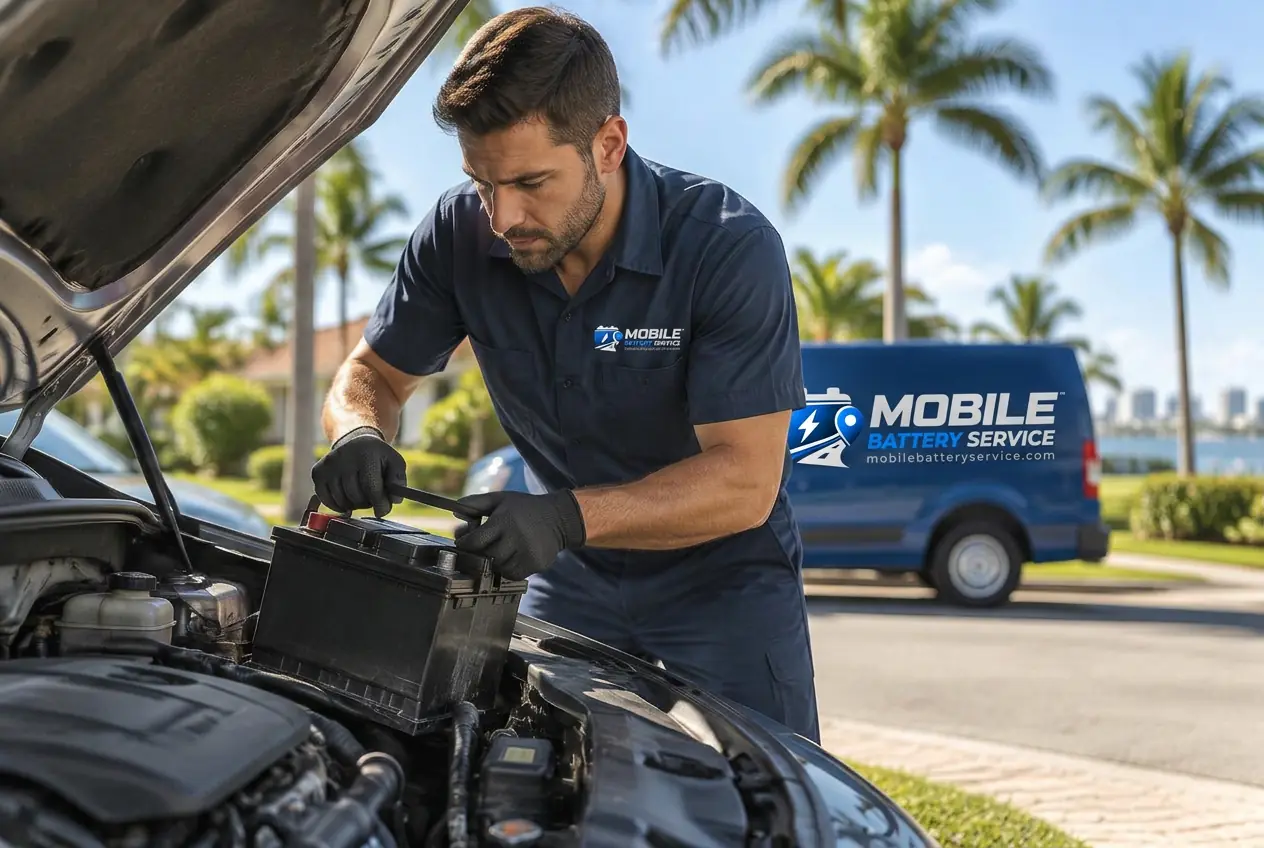
Before the next storm, let us take one thing off your list. We come to homes across Pinellas County to test and replace batteries in cars, golf carts and generators. Our car battery replacement, golf cart battery service and heavy equipment and generator battery service can all be handled in a single visit.
Related services
Related posts
Florida Heat & Seasonal Care · Sep 12, 2026 · 1 min read
How Long Do Car Batteries Last in Florida?
Heat — not cold — is the #1 battery killer. Here's what Tampa Bay drivers should expect and how to make a battery last longer.
Florida Heat & Seasonal Care · Oct 28, 2026 · 5 min read
A Florida Summer Battery Checklist for Cars, Carts and Equipment
Heat does more damage to batteries than cold ever does. Here is a practical Florida summer checklist for every battery in your driveway, garage and yard.
Car Batteries · Oct 28, 2026 · 5 min read
Parasitic Drain: Why Your Car Battery Dies Overnight
If your car starts fine one day and is dead the next morning, something may be drawing power while it is parked. Here is how parasitic drain works…
Testing & Troubleshooting · Oct 28, 2026 · 5 min read
Battery Tests Good but the Car Won’t Start: What Else to Check
The battery passed its test, yet the car still will not start. That is frustrating, but it rules out one thing. Here is what to look at next.
More posts about florida heat & seasonal care · All blog posts
Popular battery guides
- How Long Do Car Batteries Last in Florida?
- Golf Cart Batteries: Lithium vs. Lead-Acid
- Signs Your Car Battery Is Failing
- Forklift Battery Maintenance Checklist
- What to Do When Your Car Won’t Start
- AGM vs. Standard Car Batteries: Which Do You Need?
Where we work
We come to you across Hernando County, Pasco County, Pinellas County, and Hillsborough County. See all mobile battery services or read more about Mobile Battery Service.