
If you have ever stood in front of a wall of batteries and wondered why one is labeled “35” and the one next to it “H6,” you have already met battery group sizes. The group number is the single most useful piece of information when you replace a car battery, because it tells you whether a battery will physically fit in your vehicle and whether the cables will reach the posts. It does not tell you everything, but it is the right place to start.
What a group size actually describes
Group sizes are a standard set by the Battery Council International (BCI) in North America. A group number describes three things:
- The outside dimensions of the case – length, width and height.
- The terminal type and position – top post or side post, and which corner the positive post sits on.
- The hold-down style – some groups have a lip or ledge at the base that a clamp grips.
It does not describe how powerful the battery is. Two Group 35 batteries can have very different cold cranking amps, reserve capacity and construction. One might be a basic flooded battery and the other an AGM. The group just guarantees they are shaped the same way.
European vehicles often use a different naming scheme based on DIN or EN standards, which is why you will see labels like H5, H6, H7 and H8 (also called Group 47, 48, 94R and 49 in BCI terms). The “H” numbers get bigger as the battery gets longer.
Why the letters matter: the “R” and “F” problem
Some group numbers come with a letter. A Group 24F or a Group 51R means the terminals are reversed compared with the standard version of that group. The case is the same size, but the positive and negative posts are swapped.
This matters more than people expect. Install a reversed battery and the positive cable may not reach its post, or it may reach only by stretching across the top of the battery, close to metal parts of the hood or body. That is a short circuit waiting to happen. If your old battery says “R” or “F,” the replacement needs to match.
Where to find your group size
There are a few reliable ways to find the right group for your vehicle:
- Look at the old battery. The group number is usually printed on the top label or on a sticker on the side. It is often the quickest answer, with one catch: the old battery may not be the right one. A previous owner or shop may have installed whatever was on hand.
- Check the owner’s manual. Most manuals list the original battery group in the specifications section, along with minimum cold cranking amps.
- Use the year, make, model and engine. Battery fitment guides are organized this way, because the same model can take different batteries depending on the engine or trim. A V6 and a four-cylinder version of the same SUV may use different groups.
- Ask a technician to check. When we come out for a car battery replacement, we confirm the group against the vehicle, not just the old battery, before anything gets installed.
What happens if you use the wrong group
Getting close is not good enough with batteries. Here is what tends to go wrong when the group does not match:
The battery moves around
A battery that is shorter or narrower than the tray allows will not be held tightly by the hold-down. Every pothole and speed bump shakes it. Vibration is hard on the internal plates, and a loose battery can rub through a cable or crack its own case. We wrote more about this in why the battery hold-down matters.
The hood or cover does not clear
A battery that is too tall can touch the underside of the hood. On some vehicles the battery sits under a plastic cover or in a tight spot near the firewall, and even a small difference in height prevents the cover from closing.
The cables do not line up
Terminal position is part of the group for a reason. If the posts are in the wrong place, cables get strained, and strained cables crack at the terminal ends over time.
The electrical specs come up short
Some people choose a smaller group because it is what was available. Smaller cases generally hold less plate material, which usually means lower cranking amps and reserve capacity. In a vehicle with a lot of electronics, that can lead to slow starts and warning messages.
Group size is the start, not the finish
Once you know the group, there are still choices to make inside that group:
- Battery type. Many newer vehicles, especially those with start-stop systems, need an EFB or AGM battery rather than a standard flooded battery. Putting a flooded battery into a car designed for AGM can shorten its life. Our guide to AGM vs. standard car batteries covers the differences.
- Cold cranking amps (CCA). Meet or exceed what the manufacturer specifies. More is not always necessary in Florida, but less is a gamble.
- Reserve capacity. This is how long the battery can run essential loads if the charging system stops. It is a useful number for drivers who sit in traffic with the A/C on.
- Freshness. A battery that sat in a warehouse for many months may already be partly discharged. Checking the date code is worth the minute it takes.
Special cases worth knowing about
A few situations trip people up:
- Batteries in the trunk or under a seat. Some vehicles put the battery away from the engine. These often need a vented battery or a specific group with a vent tube fitting.
- Two-battery vehicles. Many diesel pickups use two batteries, and both should be the same group, type and age.
- Vehicles that need registration. On many newer vehicles, the car’s computer needs to be told a new battery has been installed so it can adjust charging. We explain why in battery registration for newer cars.
Frequently asked questions
Can I use a bigger group size if it fits?
Sometimes a slightly larger battery fits the tray and the hold-down, but often it does not. Unless the vehicle maker lists it as an option, stick with the specified group.
Is a group 24 the same as a group 24F?
Same case size, reversed terminals. They are not interchangeable in most vehicles.
Does the group size affect how long the battery lasts?
Indirectly. A battery that fits snugly and matches the vehicle’s electrical needs will usually last longer than one that is loose or undersized. In Florida, heat is the biggest factor; see how long car batteries last in Florida.
Getting the right battery without the guesswork
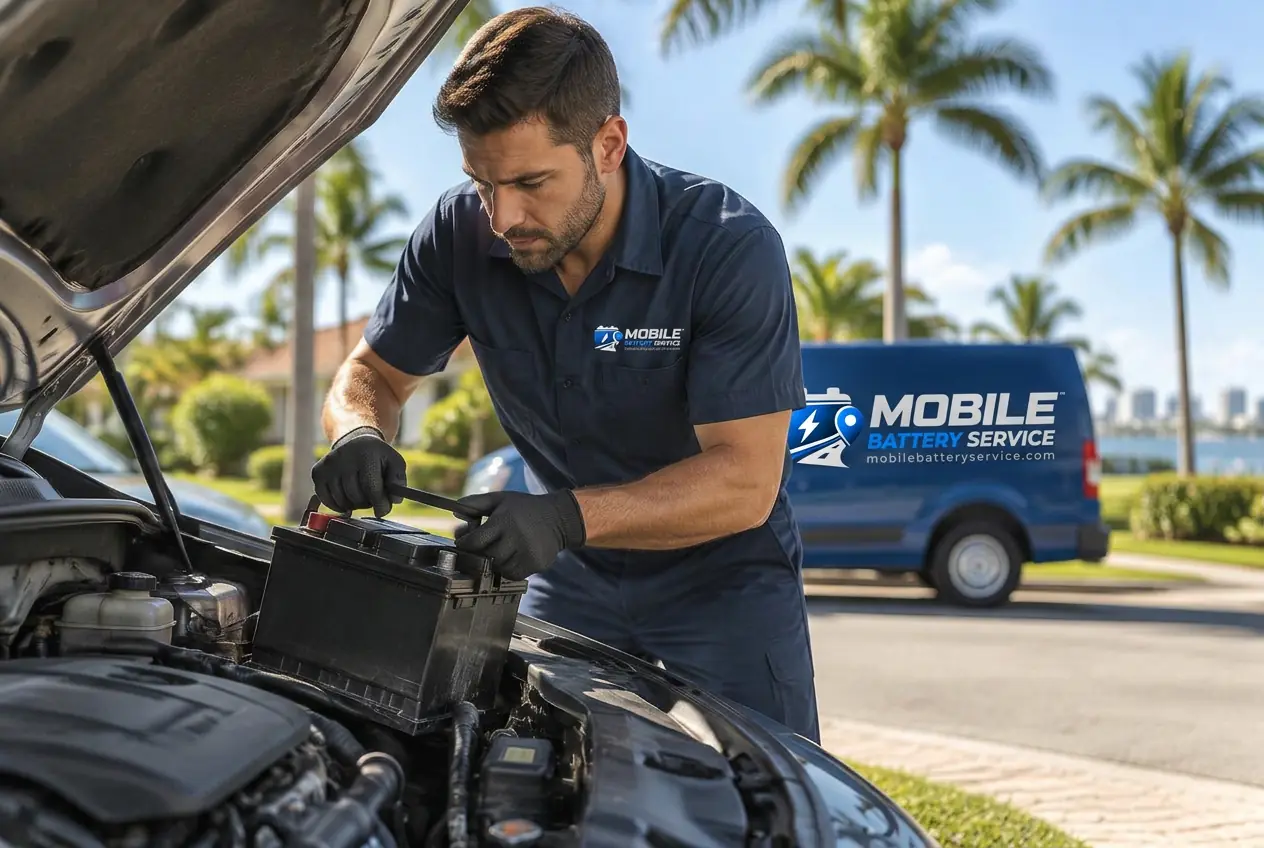
If you are not sure which group your vehicle takes, or the battery has already died, you do not need to pull it out and carry it to a parts counter. We come to you anywhere in Hillsborough County, including Tampa, test the existing battery, confirm the correct group and type, and install the replacement where the vehicle is parked. Every visit starts with a free battery test, so you only replace a battery that actually needs it.
Related services
Related posts
Car Batteries · Oct 28, 2026 · 5 min read
Why Some Newer Cars Need a New Battery Registered
On many newer vehicles, installing a battery is only half the job. The car's computer also needs to know a new battery is in place. Here is why.
Car Batteries · Oct 28, 2026 · 5 min read
Parasitic Drain: Why Your Car Battery Dies Overnight
If your car starts fine one day and is dead the next morning, something may be drawing power while it is parked. Here is how parasitic drain works…
Car Batteries · Oct 28, 2026 · 5 min read
What Causes Car Battery Terminal Corrosion and What It Tells You
That crusty white or blue-green buildup on battery terminals is a clue. Here is what causes it, why it matters, and what to do about it in Florida's…
Car Batteries · Jun 18, 2026 · 1 min read
AGM vs. Standard Car Batteries: Which Do You Need?
Start-stop systems, heat and electronics are changing which battery your vehicle needs.
Popular battery guides
- How Long Do Car Batteries Last in Florida?
- Golf Cart Batteries: Lithium vs. Lead-Acid
- Signs Your Car Battery Is Failing
- Forklift Battery Maintenance Checklist
- What to Do When Your Car Won’t Start
- AGM vs. Standard Car Batteries: Which Do You Need?
Where we work
We come to you across Hernando County, Pasco County, Pinellas County, and Hillsborough County. See all mobile battery services or read more about Mobile Battery Service.