
Not long ago, replacing a car battery was a purely mechanical job: loosen the terminals, swap the battery, tighten everything back down. On a growing number of vehicles today, there is one more step. The car’s computer needs to be told that a new battery has been installed. This is called battery registration, and skipping it can quietly shorten the life of the battery you just paid for.
What battery registration means
Many modern vehicles have a battery management system. It is not the same as the battery management system inside a lithium battery; this one lives in the car. It watches the battery’s voltage, current and temperature using a small sensor, usually mounted on the negative battery cable. You may hear it called an intelligent battery sensor or IBS.
Over time, the system learns how the battery is aging. As a battery gets older, its internal resistance rises and it accepts charge differently. To compensate, the car changes how hard the charging system pushes current into it.
When you install a new battery without registering it, the car still believes the old, worn battery is in place. It may keep charging the new battery as if it were aged, which can mean overcharging it. Registration resets that history so the car charges the new battery correctly from day one.
Which vehicles typically need it
Registration requirements vary by manufacturer and model year, so the owner’s manual or service information is the final word. In general, it is common on:
- Many BMW, MINI, Audi, Volkswagen, Mercedes-Benz and Volvo models.
- Vehicles with start-stop systems from a wide range of brands, including many Ford, GM and other domestic models.
- Some vehicles with advanced driver assistance and heavy electronic loads.
A useful rule of thumb: if the vehicle came with an AGM or EFB battery and has an engine start-stop feature, there is a good chance it uses a battery monitoring system and benefits from registration.
What happens when it is skipped
Nothing dramatic happens right away, which is why people skip it. The car starts, the lights come on, and everything seems fine. The problems show up later:
Shorter battery life
If the car keeps applying an aggressive charge meant for an old battery, the new battery can be overcharged. Overcharging heats the battery and accelerates the breakdown of the plates. In Florida, where under-hood temperatures are already brutal, that is the last thing a battery needs.
Start-stop stops working
Many vehicles disable start-stop when they think the battery is weak. If the system still has the old battery’s data, it may keep start-stop turned off, or it may behave erratically.
Warning messages
Some vehicles display battery or charging messages, or limit comfort features to protect the battery, because the data no longer matches reality.
Registration and coding are not the same thing
You may also hear the term “coding.” Registration tells the car that a new battery of the same type and capacity is installed. Coding is needed when the replacement battery is different from the original, for example switching from a flooded battery to an AGM, or changing to a different capacity. The car needs to know the battery type and size so it can use the correct charging strategy.
That is why the replacement should match what the manufacturer specifies. If you are unsure whether your vehicle needs an AGM, our comparison of AGM and standard car batteries is a good starting point, and our explainer on battery group sizes covers fit.
How registration is done
Registration is done with a scan tool that can communicate with the vehicle’s modules. The general process looks like this:
- Install a battery that matches the vehicle’s specified type and capacity.
- Connect the scan tool to the diagnostic port under the dash.
- Select the battery registration or battery replacement function for that vehicle.
- Enter or confirm battery details if the vehicle asks for them.
- Clear any stored battery-related messages and verify the system shows the new battery.
On some vehicles, there is a manual procedure using the ignition and dashboard buttons. On many, it requires the scan tool.
Signs your last battery replacement may have missed this step
If your battery was replaced and you are seeing any of the following, it may be worth having the system checked:
- The new battery seems to be failing far earlier than expected.
- Start-stop has not worked since the battery was changed.
- You get recurring messages about the battery or electrical system.
- The battery is hot to the touch or smells sulfurous after driving. Our post on rotten egg smells from a battery explains why that matters.
A battery test can show whether the battery itself is healthy, which helps separate a registration issue from a bad battery.
What we do on newer vehicles
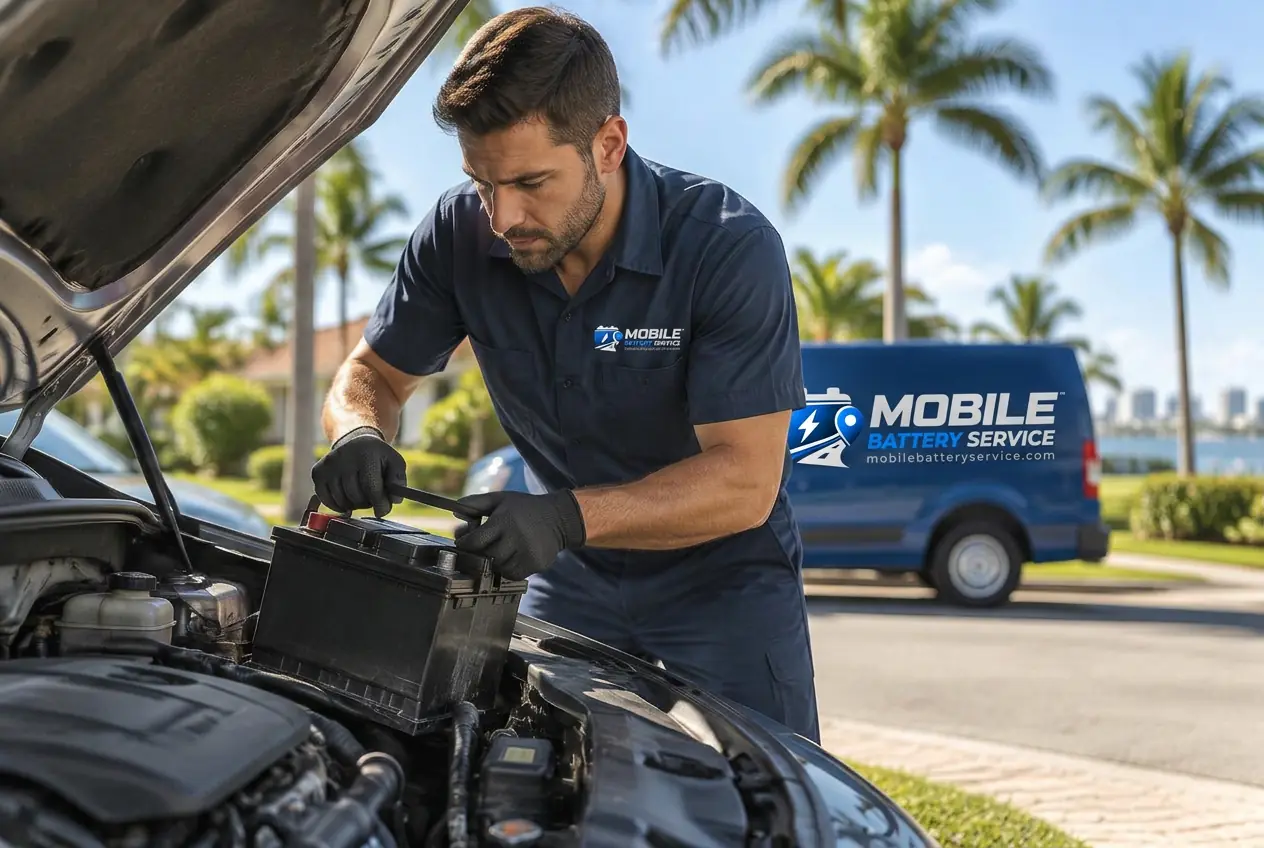
Battery registration for newer vehicles is part of our mobile car battery replacement service. When we come to you, we test the old battery, confirm the correct group and type, install the new battery, and register it with the vehicle when the vehicle requires it. That way the car’s charging strategy matches the battery that is actually in it.
Frequently asked questions
Can I register a battery myself?
Some scan tools sold to consumers can do it for certain brands. Make sure the tool supports your specific vehicle and that you select the correct battery type and capacity.
Do older cars need registration?
Most older vehicles without a battery sensor do not. If your vehicle has no sensor on the negative cable and no start-stop, registration is unlikely to apply.
Will disconnecting the battery erase settings?
It can reset radio presets, clocks, window auto-up functions and steering angle learning on some vehicles. That is a separate issue from registration. See warning lights after a battery change for what is normal.
Battery service that respects the car’s electronics
Modern vehicles are computers on wheels, and the battery is part of that system. If you drive a newer vehicle in Westchase or anywhere else in Hillsborough County, we come to you and handle the battery replacement with the extra steps your vehicle needs.
Related services
Related posts
Car Batteries · Oct 28, 2026 · 5 min read
What Car Battery Group Sizes Mean and How to Find Yours
Group 24F, 35, 48, H6, 65: the numbers on a battery label tell you whether it will fit. Here is how group sizes work and how to find…
Car Batteries · Oct 28, 2026 · 5 min read
Parasitic Drain: Why Your Car Battery Dies Overnight
If your car starts fine one day and is dead the next morning, something may be drawing power while it is parked. Here is how parasitic drain works…
Car Batteries · Oct 28, 2026 · 5 min read
What Causes Car Battery Terminal Corrosion and What It Tells You
That crusty white or blue-green buildup on battery terminals is a clue. Here is what causes it, why it matters, and what to do about it in Florida's…
Car Batteries · Jun 18, 2026 · 1 min read
AGM vs. Standard Car Batteries: Which Do You Need?
Start-stop systems, heat and electronics are changing which battery your vehicle needs.
Popular battery guides
- How Long Do Car Batteries Last in Florida?
- Golf Cart Batteries: Lithium vs. Lead-Acid
- Signs Your Car Battery Is Failing
- Forklift Battery Maintenance Checklist
- What to Do When Your Car Won’t Start
- AGM vs. Standard Car Batteries: Which Do You Need?
Where we work
We come to you across Hernando County, Pasco County, Pinellas County, and Hillsborough County. See all mobile battery services or read more about Mobile Battery Service.